
New minimalisms
Hey, it’s been a while! That’s because, in theory, this Substack is dormant/dead. But sometimes one needs to bring back the dead, right? This is one of those times, for a brief update.
I’ve got two things I’d like to tell you about, both of which involve my ongoing work related to minimalist music.
First up: I’m putting on a big conference! Every two years for the past 20 years, the Society for Minimalist Music holds a conference in the U.S. or Europe; I’ve been to almost every American version and they’re pretty much always a lot of fun. That’s because they’re not just a bunch of academic papers — which, TBH, I also find pretty fun — but also typically a line-up of concerts of really great music. Which is what I’ve spent the past year-plus working on: the University of Maryland School of Music will be hosting the 10th International Conference on Music and Minimalism this May. This has meant doing a lot of typical conference organizing stuff: putting together a call for papers, rounding up an excellent program committee, making a budget, applying for grants, etc. But it’s also meant, essentially, curating a miniature music festival (six concerts!) that complements the keynote talks and 20-minute papers, and I’ve had the privilege of drawing on the amazing resources and colleagues at my home institution for this.
So here’s the announcement:
University of Maryland School of Music Hosts 10th International Conference on Music and Minimalism, May 6–10
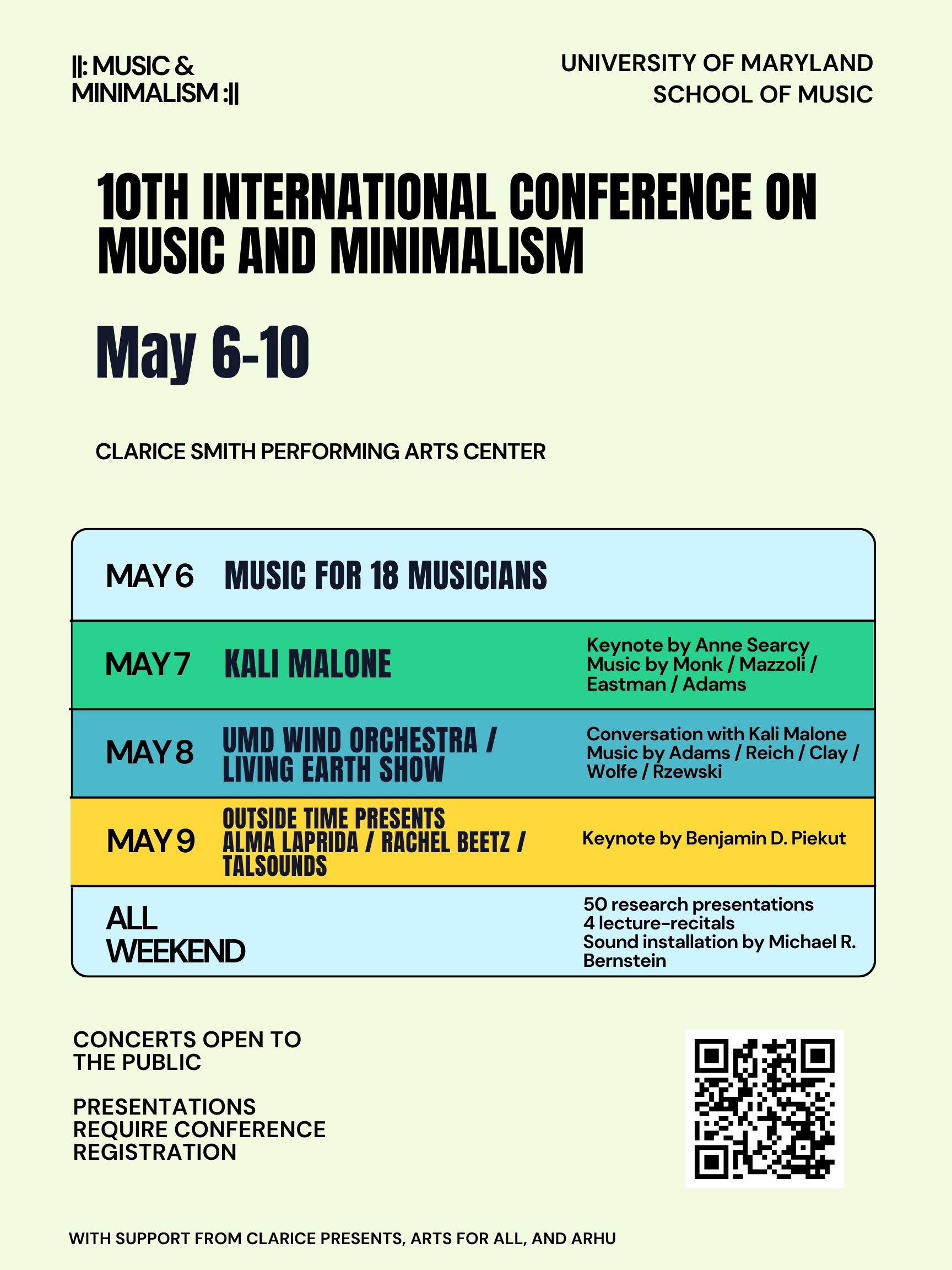
The University of Maryland School of Music will host the 10th International Conference on Music and Minimalism May 7–10, 2026, at the Clarice Smith Performing Arts Center. The four-day conference will feature keynote lectures by musicologists Anne Searcy and Benjamin Piekut; a concert by and conversation with composer Kali Malone; performances by students and faculty from the University of Maryland’s School of Music; a showcase of local experimental music presented by Outside Time; an exhibit and sound installation at the Michelle Smith Performing Arts Library; and research presentations from visiting scholars and musicians.
Highlights of the weekend:
Six concerts:
Composer Kali Malone performs her acclaimed album All Life Long on Memorial Chapel’s M.P. Moller Pipe Organ, accompanied by vocalists and brass
A fiftieth-anniversary performance of Steve Reich’s Music for 18 Musicians by School of Music students, alongside premieres of new works by UMD student composers
Faculty and students from the Voice & Opera Division present excerpts from Meredith Monk’s Atlas, arias by John Adams and Missy Mazzoli, and Julius Eastman’s Prelude To The Holy Presence Of Joan D’Arc
The UMD Wind Orchestra plays John Adams’s Grand Pianola Music and Frederic Rzewski’s Les Moutons de Panurge, as well as a new work by Danny Clay in collaboration with The Living Earth Show
An evening curated by local record label Outside Time, featuring musicians Alma Laprida, Rachel Beetz, and TALsounds
The UMD Percussion Ensemble performs Steve Reich’s Sextet; composer/clarinetist Evan Ziporyn plays Philip Glass’s Best Out of Three; the Atria String Quartet performs Julia Wolfe’s Early That Summer; and Erica Spear and Isabella Grady present a new choreography of Reich’s Vermont Counterpoint
An ongoing sound installation by composer Michael R. Bernstein, featuring homemade instruments controlled by MIDI software
Scholarly presentations:
Keynote lectures by Benjamin Piekut (Cornell), focused on minimalism as an object of historiographical inquiry, and Anne Searcy (University of Washington), on choreographing minimalism
Fifty research papers presented by scholars from around the globe
Four lecture-recitals featuring the music of Steve Reich, Terry Riley, Alma Laprida, and Laura Cetilia
An exhibit on Philip Glass’s work in Pittsburgh public schools in the 1960s, highlighting materials held in UMD’s Special Collections in the Performing Arts curated by School of Music students
A visit to the Library of Congress’s Music Division to view materials related to minimalist music, including the archival papers of composer John Adams
The preliminary conference program is available here.
The general public is encouraged to attend any of the concerts presented; attending research presentations requires conference registration.
For additional information, and to register, please visit https://www.minimalismsociety.net/umd2026
Please reach out to conference organizer Will Robin with any questions: wrobin@umd.edu
Pretty great, right? I’m very excited for Kali Malone to play our organ, and for my colleagues and students to perform Music for 18 and Grand Pianola Music, a piece I’ve wanted to hear live forever. Our opera studio is singing an excerpt from Atlas! My buddy Jonathan, who runs the fantastic label Outside Time, has put together a bill of amazing musicians who typically play at the local venue Rhizome, the best place on earth.
Also, for the past few months, composer Michael R. Bernstein has been constructing an installation that will be housed in our performing arts library during the conference: the Human Liberation Blue Tape Orchestra, a mechanical ensemble that will play minimalist-inspired drones and loops. This is what it looked like at a fun Rhizome show back in December:
And students from the minimalism seminar I’m teaching will be curating an exhibit of materials from our library’s Special Collections in Performing Arts related to Philip Glass’s work in Pittsburgh public schools in the early ‘60s (part of the Contemporary Music Project, when the Ford Foundation put composers-in-residence at public schools across the country). From Glass’s application to the program:
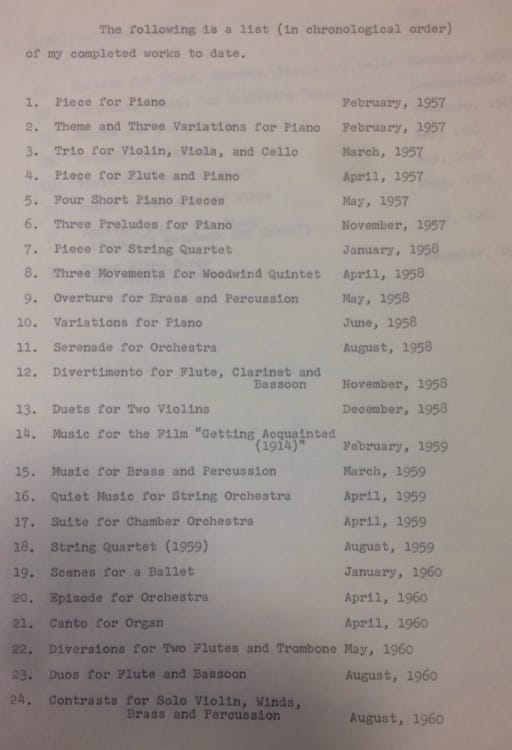
I don’t think anyone’s seen or heard any of that music since 1960….(alas, the collection at UMD does not include any scores).
Plus, 50 papers by a crew of international scholars, and keynotes by two of my favorite musicologists, Ben Piekut and Anne Searcy.
All of this is to say: please spread the word and, if you’re in the DC area, come! If you’re not an academic-conference-goer, you can skip out on the talky portions entirely and come to the concerts, most of which are free. If you have questions, hit me up. I’d love to see you there.
The other minimalism thing: remember how I co-edited a book a few years ago, called On Minimalism, with Kerry O’Brien? It happened. It’s a good book! It’s also a book that attempted a lot of things: telling a new story about minimalist music while telling the old story; adding a bevy of figures to an often-too-narrow list of minimalists, including fairly obvious choices (Ann Southam) and not-so-obvious ones (Donna Summer, Alice Coltrane); creating a narrative from 100+ primary sources; crafting the material for fellow academics but also the broader public; and emailing many, many, many people for permission to reprint documents and photos.
A lot of deep thinking went into what we included in the book, in terms of documents, people, aesthetic ideas, etc. The book itself does not reflect in-depth on those acts of inclusion (and exclusion), as we wanted to streamline the narrative and not get too hung up on navel-gazing. But navel-gazing is pretty important to academia; we musicologists do love looking at our scholarly tummies, so to speak. So, to provide an opportunity to do so, I convened a panel at the Society for American Music conference in Detroit in 2024 of fellow minimalists scholars, to respond to the book’s contents and methodology.
It was a lot of fun, so we decided to write it down. Hence a new colloquy — a group of four essays plus a short intro by me — on the topic of minimalism and the politics of inclusion, recently published in the Journal of the Society for American Music.
The colloquy is publicly available (open access) here. I recommend checking out the PDF here, as it’s a cleaner read.
I would really recommend reading it! Sumanth Gopinath, Victor Szabo, Patrick Nickleson, and Kerry O’Brien are among my favorite thinkers about experimental/minimal/ambient music, and each essay engages with how the politics of race, gender, and genre have informed what minimalism has meant. There are some robust critiques of On Minimalism I agree with, and others I don’t, but they’re all well-argued and deeply fascinating.
Even if you don’t care about minimalist music, it’s a good read for thinking through questions of how aesthetic categories emerge, what it means to preserve or battle against or expand them, and how artists (especially from marginalized groups) navigate their relationship to such categories. I’m very proud of how it turned out, and if you’re an On Minimalism fan it’s an ideal companion for the reader.
Don’t worry, I’m not planning on relaunching the Substack (I have three human children now, who has time for a newsletter?!). But I may occasionally drop in to plug new projects as they emerge, since I’ve mostly abandoned social media. Two journal articles of note that will be out at some point in the future: an analysis of John Adams’s early work in light of archival discoveries, including a revelatory and game-changing journal he kept in the 1970s, at the Library of Congress; and a longer meditation on public musicology and how I have practiced it. See you not-so-soon.